November 21, 2025
Introduction
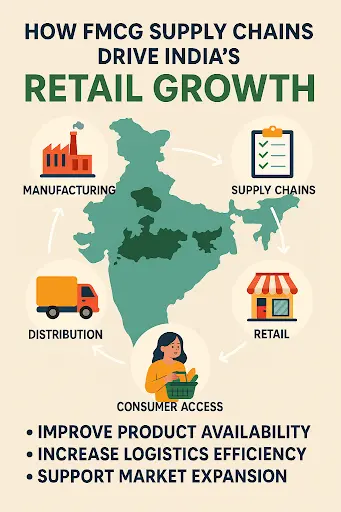
The Fast-Moving Consumer Goods (FMCG) sector is one of the strongest pillars of India's retail economy. With rising population, urbanisation, and consumption habits, the FMCG industry plays a vital role in how retail formats function—traditional and modern. This article explores how FMCG supply chains contribute to India's retail growth by improving product flow, logistics efficiency, and market accessibility.
1. FMCG as the Backbone of Retail Demand
India's retail market depends heavily on everyday essentials like packaged foods, personal care items, beverages, detergents, and household supplies. These products have high turnover rates, making them central to the growth of both supermarkets and small grocery shops. Consistent FMCG demand ensures stable retail sales throughout the year, unlike seasonal industries.
2. How Supply Chains Improve Product Availability
A strong FMCG supply chain focuses on fast distribution, efficient warehousing, and reliable stock replenishment. Retailers—small and large—depend on quick restocking to avoid product shortages and maintain sales velocity. FMCG franchise models in India, such as SastaKirana, are often studied for their simplified retail structure and distributor-retailer support systems. These structured models help beginners understand procurement, wholesale pricing, and stock rotation—areas where first-time entrepreneurs often face challenges.
3. Logistics and Distribution Efficiency
India's FMCG supply chain includes multiple layers: manufacturers, distributors, wholesalers, and retailers. Improvements in logistics—such as better road networks, digital tracking, and modern warehouses—have transformed the speed and accuracy of product delivery. Faster movement of goods enables retailers to operate smoothly and maintain consistent stock.
4. Supporting the Growth of Modern Retail Formats
The rise of supermarkets, mini-markets, micro-stores, and convenience shops in India is directly linked to efficient FMCG supply systems. Modern retail requires:
- Timely delivery
- High product range
- Stable distributor partnerships
- Predictable pricing
FMCG supply chains make it possible for modern stores to offer a seamless shopping experience that matches evolving consumer expectations.
5. Impact on Rural and Semi-Urban Markets
FMCG companies have expanded their distribution networks deep into rural and semi-urban India. This has allowed small local retailers to access branded products at better prices and shorter delivery times. As a result, retail growth is no longer limited to major cities—small towns are also becoming strong retail hubs.
6. Digitalisation and Future Transformation
Technology is becoming central to FMCG distribution. Retailers now use digital ordering apps, automated billing, and inventory tracking systems to manage stock more efficiently. These advancements reduce supply chain gaps and ensure better coordination between retailers and suppliers.
Conclusion
The FMCG supply chain is a major driver of India’s retail growth. By improving product availability, distribution efficiency, and market accessibility, it strengthens both traditional and modern retail systems. As India’s consumer expectations evolve, strong FMCG supply chains will continue to shape the future of retail, ensuring faster service, wider variety, and better shopping experiences.